
How Global Building Disasters Can Improve Future Safety
Building disasters leave behind difficult but important lessons. By studying what went wrong, the construction industry can improve building codes, inspections, maintenance, emergency planning, and ultimately prevent similar tragedies in the future.
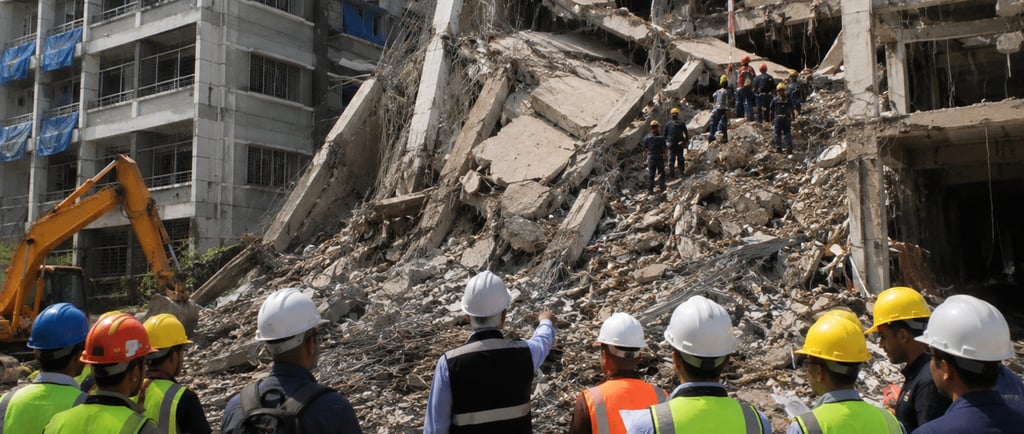
I have spent much of my career studying buildings, construction defects, fires, structural failures, and the conditions that can turn a small problem into a major disaster.
One thing becomes clear when you study these events:
Disasters are different, but the lessons often repeat themselves.
Whether we are looking at a high-rise fire, a building collapse, or another major failure, we usually find a combination of warning signs, aging systems, poor maintenance, questionable materials, inadequate inspections, or decisions that should have been questioned earlier.
I have explored many of these subjects in my books, including the Grenfell Tower fire, the Florida building collapse, the Lahaina wildfire, and other construction and building safety issues.
The purpose of studying these tragedies should never be simply to assign blame.
The real question is: What can we learn so it does not happen again?
Every Failure Tells Us Something
After a building disaster, investigators look at what failed.
Was it the structure?
The materials?
The fire protection?
The maintenance?
The inspection process?
The emergency response?
Sometimes there is one major cause. More often, there are several problems that developed over time and eventually came together.
That is why investigations are so valuable.
A failure can reveal weaknesses that may exist in thousands of other buildings.
In my book Inferno by Design, I discuss how the lessons from the Wang Fuk Court fire extend beyond one location. Aging buildings, changing materials, renovation work, and gaps in oversight are concerns that can exist in cities around the world.
When we find these patterns, we have an opportunity to act before another tragedy occurs.
Codes Should Learn From Real-World Failures
Many building codes and safety standards have improved because something went wrong first.
That is unfortunate, but it is also one of the ways the construction industry advances.
When a disaster exposes a weakness, we should ask whether existing codes are enough.
Do older buildings need upgrades?
Should certain materials be restricted?
Are inspection requirements frequent enough?
Should renovation projects receive more oversight?
Rules should not remain unchanged simply because they worked in the past.
Buildings change, technology changes, and our understanding of safety changes.
The code should change with it.
Inspection and Maintenance Cannot Be Ignored
One of the most important lessons from major building failures is that safety does not stop when construction ends.
Buildings age.
Concrete deteriorates.
Steel corrodes.
Waterproofing fails.
Fire alarms and sprinklers require maintenance.
Renovations can introduce new risks.
Regular inspections help identify those problems before they become emergencies.
As I wrote in Inferno by Design, inspections should be independent, recurring, and enforced. Life-safety systems such as sprinklers, alarms, protected stairwells, and refuge areas should not be treated as luxuries.
A building that was safe twenty years ago still needs to be evaluated today.
We Have to Share the Lessons
A disaster in another country may feel far away.
But buildings around the world often share similar materials, construction methods, design concepts, and maintenance challenges.
That means a lesson learned in Hong Kong, London, Florida, or Hawaii may help protect a building somewhere else.
Engineers, architects, contractors, inspectors, building owners, and government agencies should study these events and share what they learn.
We should not wait for the same failure to happen twice before taking action.
The Bottomline
Every building disaster leaves us with a responsibility.
We can look at what happened, shake our heads, and move on.
Or we can learn from it.
Study the failure.
Improve the codes.
Inspect older buildings.
Maintain life-safety systems.
Pay attention to warning signs.
And make changes before another disaster forces us to.
The best lesson we can take from a building failure is the one that helps prevent the next one.
Lance Luke
National Building Expert


Lance Luke 2026 © International Building Expert
LANCE LUKE
International Building Expert — Commentary, Books & Global Insights
Building safety expertise across continents. From forensic analysis to historic preservation.
CONNECT
(808) 754-3425
lanceluke@hawaiibuildingexpert.com